NOTE: This disposition is nonprecedential. United States Court of Appeals
for the Federal Circuit
EDGE SYSTEMS LLC,
Plaintiff-Appellant
v.
CARTESSA AESTHETICS, LLC,
Defendant-Cross-Appellant
2025-1119, 2025-1190
Appeals from the United States District Court for the Eastern District of New York in No. 2:20-cv-06082-GRBST, Judge Gary R. Brown.
Decided: November 18, 2026
ALI S. RAZAI, Morgan, Lewis & Bockius LLP, Costa Mesa, CA, argued for plaintiff-appellant. Also represented by JULIE S. GOLDEMBERG, Philadelphia, PA.
STEVEN P. TEPERA, Pillsbury Winthrop Shaw Pittman LLP, Austin, TX, argued for defendant-cross-appellant. Also represented by MICHAEL H. BOROFSKY, JAMES QUAIL; ANNE M. VOIGTS, Palo Alto, CA.
2Before PROST, HUGHES, and CUNNINGHAM, Circuit Judges.
Edge Systems LLC (“Edge”) sued Cartessa Aesthetics, LLC (“Cartessa”) in the U.S. District Court for the Eastern District of New York, alleging that Cartessa infringed U.S. Patent No. 9,550,052 (“the ’052 patent”). As relevant here, the district court granted two motions for summary judgment—one for noninfringement, the other for no invalidity. Edge appeals as to noninfringement, and if we were to disturb that judgment, Cartessa cross-appeals as to no invalidity. For the reasons below, we (1) vacate the summary judgment of noninfringement and remand for further proceedings; and (2) affirm the summary judgment of no invalidity.
BACKGROUND
I
The ’052 patent concerns a system for skin treatment. Claim 1, which is representative for present purposes, has the following relevant elements:
a console including a manifold, the manifold being in fluid communication with a first fluid container and at least a second fluid container, the first fluid container and the at least the second fluid container being configured to contain a treatment material for a skin treatment procedure, wherein the treatment material comprises a liquid; . . . wherein the manifold is configured to control a flow of treatment material from the first fluid container and at least the second fluid container through the supply conduit; . . .
3wherein the system is configured to permit a user to select the treatment material from the first fluid container or the at least second fluid container to be delivered through the supply conduit to the handpiece assembly.
’052 patent claim 1 (emphasis added).
II
Edge sued Cartessa in December 2020, alleging that Cartessa infringed the ’052 patent via the accused Skinwave system.1
The parties eventually cross-moved for summary judgment regarding infringement. Although the parties had previously agreed that “manifold” did not require construction and should instead just be given its plain and ordinary meaning, their summary-judgment briefing nonetheless exposed a disagreement over what that meaning was. Cartessa argued that the claimed manifold must be able to “combin[e] multiple sources into a single outlet”—that is, draw fluid from multiple containers simultaneously so that they are “intermix[ed] during use.” See J.A. 8292–93. Under that view, it is undisputed that the Skinwave system does not satisfy the elements of claim 1. See, e.g., Appellant’s Reply Br. 12; see also J.A. 5029. Edge, however, argued that the claimed manifold was simply “a component with one outlet and several inlets, for connecting with other pipes.” See J.A. 8173 (cleaned up); see also J.A. 8171. Under that view, Edge maintained that there was no genuine dispute that the Skinwave system has the required manifold.
4Edge also moved for summary judgment that the ’052 patent was not invalid. It observed that Cartessa’s only invalidity defense was anticipation over U.S. Patent No. 6,162,232 (“Shadduck”). And it argued that no reasonable jury could find by clear and convincing evidence that Shadduck discloses either of two elements of claim 1: (1) a manifold, or (2) the capability of selecting from among multiple containers of liquid treatment material.
The district court granted summary judgment of noninfringement and of no invalidity. Edge Sys. LLC v. Cartessa Aesthetics, LLC, No. 20-CV-6082, 2023 WL 3847138 (E.D.N.Y. June 6, 2023) (“SJ Order”).
As to noninfringement, the district court began by reproducing Edge’s annotated image of the Skinwave system, with the white box labeled as the manifold:
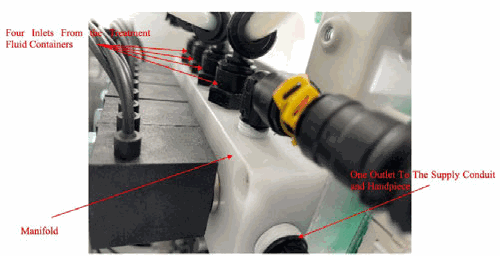
Id. at *3 (citing J.A. 1067 ¶ 23). The court further observed that Edge did not meaningfully dispute Cartessa’s argument that Edge’s expert “remained unaware of [the white box’s] internal structure and composition, did not detach [it] from the console, did no destructive testing and could not remember even touching [it].” Id.
When turning to its infringement analysis, the district court noted the parties’ competing views on the meaning of “manifold,” but it deemed those views irrelevant. Instead, it concluded that Edge’s evidentiary shortcomings meant5 that, “however one might construe the functions of a manifold, Edge cannot prove that the Skinwave device contains one.” See id. at *5.
As to no invalidity, the district court concluded that no reasonable jury could find by clear and convincing evidence that Shadduck discloses either the “manifold” or “the multiple liquid container” elements of claim 1 of the ’052 patent. See id. at *4.
The district court entered its final judgment in accordance with a stipulation of the parties. Edge timely appealed, and Cartessa timely cross-appealed. We have jurisdiction under 28 U.S.C. § 1295(a)(1).
DISCUSSION
We review a district court’s grant of summary judgment under the law of the regional circuit—here, the Second Circuit, which reviews such grants de novo. Focus Prods. Grp. Int’l, LLC v. Kartri Sales Co., 156 F.4th 1259, 1271 (Fed. Cir. 2025) (citing and applying Second Circuit law). “Summary judgment is properly granted only when, drawing all reasonable inferences in the nonmovant’s favor, there exists no genuine issue of material fact and the movant is entitled to judgment as a matter of law.” Id.; see also Anderson v. Liberty Lobby, Inc., 477 U.S. 242, 252–55 (1986) (holding that the evidentiary standard of proof that would apply at trial is incorporated into the summary-judgment inquiry).
Infringement and anticipation are both questions of fact. E.g., ATEN Int’l Co. v. Uniclass Tech. Co., 932 F.3d 1364, 1367 (Fed. Cir. 2019). At trial, infringement must be proven by a preponderance of evidence, while anticipation must be proven by clear and convincing evidence. See, e.g., Eli Lilly & Co. v. Hospira, Inc., 933 F.3d 1320, 1328 (Fed. Cir. 2019) (infringement); Bd. of Regents of the Univ. of Tex. Sys. v. Bos. Sci. Corp., 184 F.4th 618, 624 (Fed. Cir. 2026) (anticipation).
I
We begin with the summary judgment of noninfringement. The district court acknowledged the parties’ dispute over the meaning of “manifold” but did not resolve that dispute. Instead, the court concluded that, “however one might construe” the term, Edge’s evidence did not create a triable issue of infringement. See SJ Order, 2023 WL 3847138, at *5.
We disagree that construing “manifold” was unnecessary. Under Edge’s construction of the term—“a closed space with several inlet pipes and one outlet,”2 Appellant’s Reply Br. 3–4—we believe that a reasonable jury could find the relevant claim element(s) satisfied, at least with reference to the below image from the district court’s order:
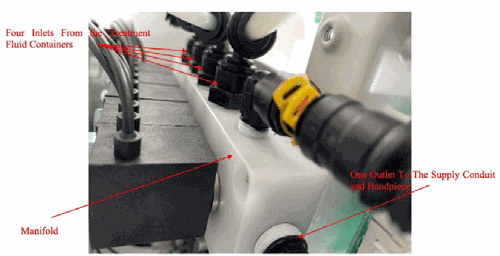
SJ Order, 2023 WL 3847138, at *3. And as we noted above, if instead Cartessa’s construction is adopted, Edge 7concedes that the Skinwave system does not satisfy the elements of claim 1. See, e.g., Appellant’s Reply Br. 12 (“Under Cartessa’s construction the accused Skinwave device does not have a manifold . . . .”).
A proper determination on infringement therefore requires resolving—to at least some extent—the parties’ claim-construction dispute over “manifold.” Because we conclude that the district court is better positioned to resolve that dispute in the first instance, we vacate the summary judgment of noninfringement and remand for it to do so. See, e.g., UTTO Inc. v. Metrotech Corp., 119 F.4th 984, 995–96 (Fed. Cir. 2024) (exercising discretion to remand for further proceedings on a claim-construction issue).
Although Cartessa urges us to affirm anyway, its arguments for that result are unpersuasive.
First, Cartessa argues that Edge waived (or forfeited) any ability to seek its preferred construction of “manifold” by failing to raise the issue during claim construction. See Cross-Appellant’s Br. 46–50. We see no waiver or forfeiture under the circumstances here. “[P]arties in patent cases frequently stipulate to a construction . . . , only to have their dispute evolve to a point where they realize that a further construction is necessary.” GE Lighting Sols., LLC v. AgiLight, Inc., 750 F.3d 1304, 1310 (Fed. Cir. 2014). Here, as Edge recounts—and as Cartessa does not meaningfully or persuasively dispute—the divergence between the parties’ understanding of “manifold” became apparent only as of the deposition of Cartessa’s expert Dr. Jensen, which came after claim construction but before summary-judgment proceedings. See Appellant’s Br. 9–15. Edge then raised the issue with the district court in its summary-judgment-related filings. See, e.g., J.A. 5032–33 (“The parties’ primary dispute . . . is therefore not a factual dispute but, rather, a purely legal dispute on claim construction [regarding ‘manifold’] that the [c]ourt may resolve on summary judgment.”); J.A. 8171 (“[T]he [c]ourt8 should reject Cartessa’s improperly narrow construction of [c]laim 1’s ‘manifold’ limitation.”). Under these circumstances, we reject Cartessa’s waiver or forfeiture argument.
Second, Cartessa asks us to affirm on other alternative grounds that the district court did not reach. For example, Cartessa argues that (1) the Skinwave system also lacks the claimed “fluid communication,” Cross-Appellant’s Br. 59–64; and (2) Cartessa is not a direct infringer, because—in its view—the ’052 patent’s claims do not cover the Skinwave system “as sold by Cartessa; rather, they claim a system that is only completed and brought into existence, if at all,” by an end user, id. at 64–65. We decline to take up these arguments in the first instance. Instead, on remand, the district court may consider whether and how to resolve them.
In remanding for further claim-construction and summary-judgment analysis, we note two principles that may become relevant. First, a court is not bound to accept either party’s preferred construction of a term. See, e.g., Bancorp Servs., L.L.C. v. Sun Life Assurance Co. of Can. (U.S.), 687 F.3d 1266, 1274 (Fed. Cir. 2012) (courts “may construe the claims in a way that neither party advocates”); cf. Vivid Techs., Inc. v. Am. Sci. & Eng’g, Inc., 200 F.3d 795, 803 (Fed. Cir. 1999) (observing that claim terms need be construed “only to the extent necessary to resolve the controversy”). Second, to whatever extent the proper construction of “manifold” requires knowledge of internal structure or functionality (as opposed to something externally observable or provable), Edge’s evidentiary limitations will likely be that much more relevant.
II
We turn now to the summary judgment of no invalidity. We affirm, because we conclude that no reasonable jury could find by clear and convincing evidence that Shadduck9 discloses a system configured to let a user “select the treatment material [comprising a liquid] from the first fluid container or the at least second fluid container,” as claim 1 of the ’052 patent requires.
At the outset, we note that it is unclear whether the district court’s summary-judgment order relied on this “selectable” ground. On the one hand, the order says—under a heading titled “Relevant Undisputed Facts”—that (1) Shadduck “clearly . . . does not” disclose a system “that allows the user to select treatment liquid from multiple containers”; and (2) Edge “convincingly distinguishes” Shadduck as to claim 1’s “requirement of multiple selectable fluids.” See SJ Order, 2023 WL 3847138, at *2 (emphasis added) (cleaned up). On the other hand, the “Discussion” section of the order references the absence of the “multiple liquid container element,” id. at *4—seemingly conveying that Shadduck’s problem was not so much the absence of selectable containers, but rather, the absence of multiple liquid containers at all. Moreover, Edge itself believes that the district court did not reach the selectable ground. See Appellant’s Reply Br. 58.
Regardless, even if the district court’s summary-judgment order did not rely on this ground, we may affirm a summary judgment “on a ground supported in the record but not addressed by the district court” if we conclude that there is no genuine issue as to a material fact. E.g., AquaTex Indus., Inc. v. Techniche Sols., 479 F.3d 1320, 1328 (Fed. Cir. 2007). And here, the record well supports that there is no genuine issue as to whether Shadduck discloses the selectable element.
Cartessa relies primarily on Shadduck’s trigger mechanism as disclosing the selectable element. Generally, Shadduck discloses a system having a handheld device that does three things: (1) delivers high-pressure gas to a patient’s skin; (2) delivers a cooling and abrasive fluid (often described as a liquid with crystals) that intermixes with10 the high-pressure gas before hitting the skin; and (3) uses negative pressure to aspirate debris from the skin for capture and removal. See, e.g., Shadduck Abstract, col. 1 ll. 26–35, col. 3 ll. 47–50, col. 4 ll. 6–64, col. 9 ll. 40–45. Shadduck describes the trigger mechanism as follows:
[T]he trigger mechanism 88 . . . has a repose OFF position and a 1st ON position and a 2nd ON position. The 1st [ON] position actuates the 1st delivery means 30 and negative pressure source 80 to thereby jet gases through the interior chamber and aspirate the gases. The 2nd ON position of the trigger 88 actuates the 2nd delivery means 40 to deliver cooling fluid . . . and crystal agent . . . into the gas streams 36A–36B and against the patient’s skin while still actuating the 1st and 2nd delivery means.
Id. at col. 10 l. 59–col. 11 l. 1 (emphasis added); see also Cross-Appellant’s Br. 82 (quoting this portion of Shadduck). So, according to this disclosure, the trigger mechanism has two “ON” positions. The “1st [ON] position” actuates both (1) “delivery means 30,”3 which Shadduck consistently describes as a “gas positive (+) pressure source” that “provide[s] gas inflow pressures,” see, e.g., Shadduck Figs. 2A–9B, col. 9 ll. 25–39 (capitalization normalized), and (2) “negative pressure source 80,” which is used for aspirating debris, see, e.g., id. at col. 10 ll. 28–41. The “2nd ON position” actuates “delivery means 40” to deliver the cooling and abrasive fluid into the gas so that the two are intermixed. See id. at col. 10 l. 64–col. 11 l. 1.
Shadduck’s trigger mechanism thus lets a user select between gas and gas-plus-liquid. Claim 1’s selectable 11element, however, requires letting a user select between “liquid” and “liquid” treatment materials. See ’052 patent claim 1 (reciting “select[ing] the treatment material”— which “comprises a liquid”—“from the first fluid container or the at least second fluid container” (emphasis added)). Although Cartessa maintains that Shadduck’s trigger mechanism lets a user “activate different delivery sources,” Cross-Appellant’s Br. 82, that alone does not satisfy claim 1’s selectable element, for the reason just noted. We conclude that no reasonable jury could find by clear and convincing evidence that Shadduck discloses claim 1’s selectable element, and we therefore affirm the district court’s summary judgment of no invalidity.
CONCLUSION
For the foregoing reasons, we (1) vacate the summary judgment of noninfringement and remand for further proceedings; and (2) affirm the summary judgment of no invalidity.
VACATED-IN-PART, AFFIRMED-IN-PART, AND REMANDED
COSTS
Costs to Edge.
Footnotes
- ↩ 1 Edge also brought infringement claims as to other patents, but those claims were later dismissed in accordance with a joint stipulation of the parties. See J.A. 12–13.
- ↩ 2 Although the precise phrasing of Edge’s proposed construction has not been entirely uniform throughout this litigation, compare, e.g., J.A. 8171 (“a pipe or closed space in a machine that has several openings, allowing liquids and gases to enter and leave”), with Appellant’s Br. 25 (“a closed space with one inlet and several outlets or one outlet and several inlets”), we deem any differences among its relevant proposals immaterial for purposes of resolving this appeal.
- ↩ 3 Shadduck alternatively refers to this component as “delivery source 30.” See, e.g., Shadduck col. 9 ll. 25–28, col. 10 ll. 56–58.